
The Sculpture Trail starts from Broxbourne Woods West Car Park.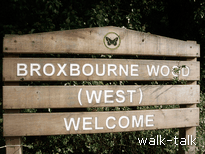
We
cross the car park and a track going to the left and go left on to a
yellowy-white sanded path at least a metre wide.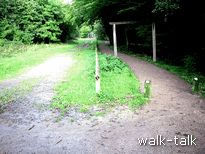 There is a post archway over it.
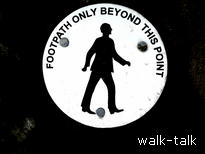 e to the Sculpture Trail is marked by two low posts,
each topped by a walking man in a white disk.
The trail is designed for disabled access and is hard underfoot.
The sculpture trail is only half a mile long and we go clockwise round it, keeping to the hard-surface trail until we reach the Broxbourne Wood East car park.
It is easy to miss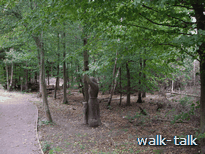 the first sculpture
of a peasant woman and child,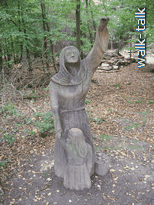 a life size carving
of a woman reaching up foraging for wild fruits, berries, nuts and fungi. The woods would
have been an important free source of food to supplement their diet.
Snuggling in to the woman's skirts is a girl and there is a
basket by their side. Neither look cheery. I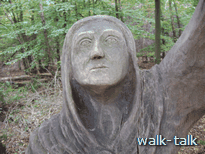 t
must have been one long picnic and barbecue but hard work and scary.
The next carving looks like
a seat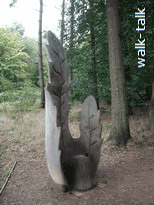 but the ball at its base is uncomfortable: I have tried it.
It represents the hornbeam’s distinctive winged seed, supposedly having fluttered to the ground ready to take root. It is about a million times life size.
The hornbeam seeds forms in clumps on the tree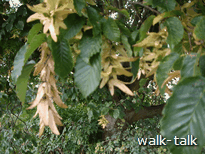
Here are two real hornbeam seeds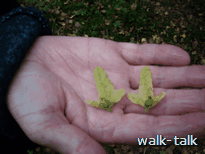 . The leafy bits are a bit
flatter than in the sculpture -
unless you squeeze them.
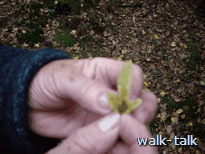
When the seed is younger - greener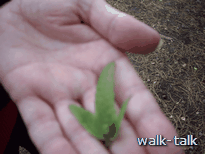 - the leafy bits curl
round more.
I like the dark, hairy
wild boar and piglets.
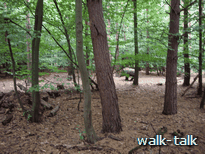
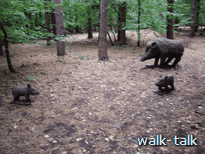
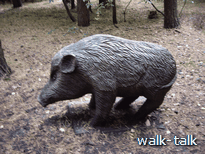
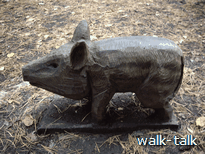
We get a glimpse of them through the trees, then see them as a family and then can examine the mum and each piglet.
Wild boar used to roam the woods grubbing for acorns “and other tasty niblets” says the Woodland Trust leaflet, uncharacteristically unspecific. Do they eat slugs and grubs and worms or only vegetable foods? we are left wondering.
The boar would have been hunted in the stone, bronze and iron ages by the people who lived in these woods. Later, of course, land owners kept strict controls on hunting.
I know in Africa the
warthog, which looks very similar, can be dangerously aggressive, especially the
females when they have young to protect and I can imagine that hunting the boar
here would have needed team work, careful planning and sharp robust weapons.
Close
together are the next two carvings.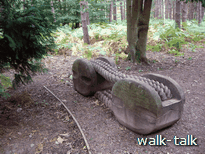
First is the pulley seat representing the hornbeam block and tackle used in shipping and by army engineers in World War II. Rifle butts were also made at that time from the hardwearing hornbeam wood.
Second
is the charcoal burner,
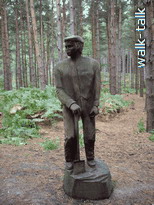 a blackened figure leaning on his shovel.
Behind is a clamp, the carefully piled mound of harvested wood, which was lit and covered with earth so that it would burn very slowly and turn into charcoal. The hornbeam has been called “Hertfordshire gold” because most of London’s hearths were fired by hornbeam charcoal which burns efficiently.
We turn and go on to the
acorn
seat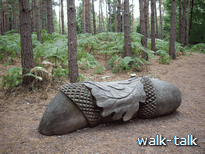 , a rather double-ended-phallic creation carved from local oak. We are
invited to “sit and connect with the wood from the mighty oak, a tree of
power, strength and safety”. Hmm.
Then
c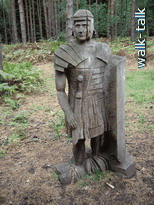 omes the Roman soldier, a bit off course for Ermine Street, the 200-mile
long Roman road connecting London with York.
Ancient pollards line the section of Ermine Street that cuts north to south through the woods a mile and a half north east marking the line between Broxbourne Woods and Hoddesdonpark Woods.
We come into Broxbourne Woods East Car Park.
(If you have had
enough of it all, you can go left through the car park and keep going on the
purple trail while it keeps close to, and parallel to, Pembridge Lane. Where the purple
trail goes left away from the road at a bench, follow it over boards until you
get to the pile of logs then turn back on yourself but a bit to the right, and
follow the butterfly trail back to Pembridge Lane, point 4 on the map. You cross
the road at a slight diagonal right,
back into the field with the odd little hexagonal-roofed duck shelter. Retrace
your steps to The Woodman.)
If you are coping, we continue
on the sculpture trail to take in one more sculpture and another route
back.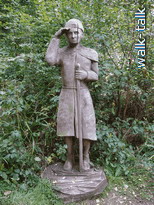
The last of the sculptures is a herder looking for his cattle.
There is a pantomime quality to this as we want to shout
“They're behind you!”
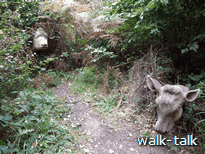 for there in the foliage
are
the heads of a cow - or
bull or ox.
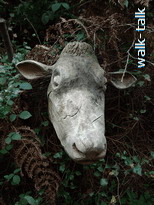
What do we think of the beast's face?
This one has a narrow forehead that
makes it look, to me, two-bob short.
Apparently the boundary ditches to be seen in the woods are evidence that the land was at one time used to graze cattle, and certainly the name of the adjacent wood, Cowheath, suggests grazing cattle were hereabouts at some time.
On a Woodland Trust guided walk around Penn Woods we were told that they use cattle there to keep some areas open to light and aid biodiversity.
We might think of cattle as eating only grass but the horizontal line of foliage on oaks and other trees in pasture shows the reach of cattle or sheep. Leaves that poke lower get nibbled off.
We are soon back at the Broxbourne Wood West Car Park, point 8, ready to go on up to point 6 on the map and back to The Woodman.