
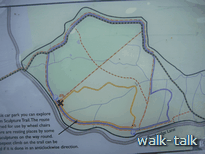
In Broxbourne Wood West Car Park there is a map that shows us the butterfly and purple trails so that we can see the way we have come.
We are at the mark x on the map and can see the straight track running due north east that will take us back to join the joint butterfly and purple trails, point 6 on our walk.
From there we shall retrace our steps to The Woodman.
The start of the straight track is to the left of the start of the Sculpture trail.
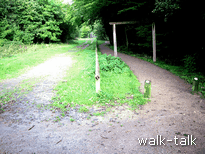
The track is as straight as it looks on the map
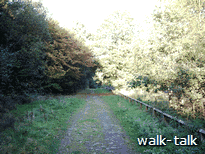 and it is wide and firm
underfoot with the patches of asphalt that we have seen on other tracks.
The low fence on the right ends in clumps of bracken and then the trac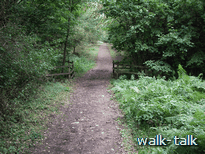 k slopes
markedly downwards, over a watercourse crossing with fencing on either, and up
the other side.
We pass a bench
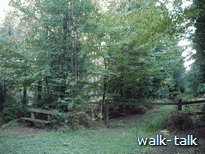 on
our right with an opening into the woodland beside it,
and we ignore a footpath off to the left.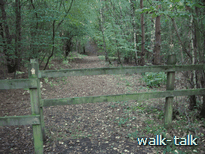
On our right here there is pine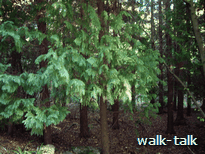 on the right with an occasional hornbeam at the edge of the track.
On the left there is a good ditch
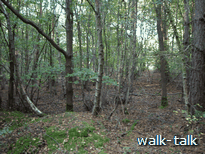 and
bank and beyond that mostly pine but also some birch trees.
We pass on our right a narrow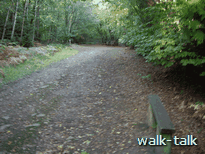 bench with no back to it and soon after that come up to our familiar
bench
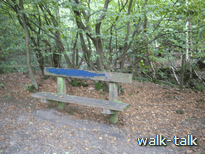 with
blue paint on its left back.
We are at point 6 and we want to go right.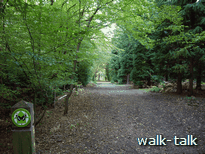
Soon we see the timber shelter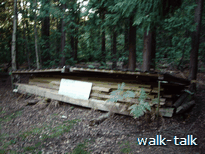 ,
now on our right.
The track is still wide and firm.
Although we might prefer not to retrace our steps at all, I find that coming from the opposite direction,
I notice different things .
In the ditch on the left, there are wetland plants.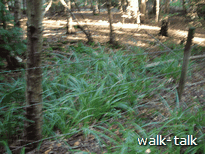
I think we called the ditch a watercourse
when we were coming the other way.
The track curves markedly to the left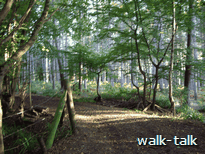 but the fence
and well made track leave us in no doubt of the way to go.
The pink bark, soaring stems
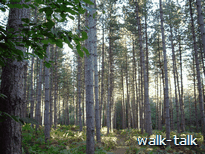 and
green bracken beneath are beautiful.
The track cu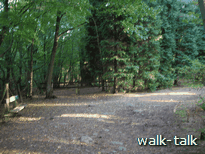 rves
left and then we see our next
blue-s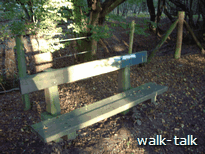 plashed
bench ahead and on our left.
We are at point 5 on our walk: we have been following the joined butterfly and purple tracks but
now we continue on the butterfly-only trail
through the double-barred, offset fences.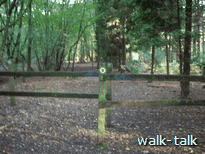
We pass a deep
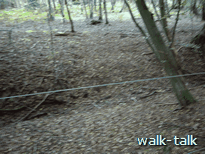 indentation
and a fence corner.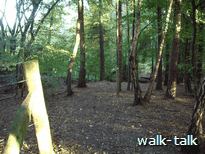
The track slopes down gently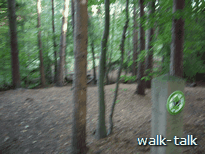
then steeply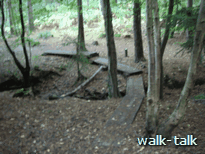 and on to boards over the watercourse.
There is a footpath waymark
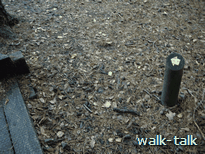 on
a low post directing us: unnecessary but reassuring.
The path wiggles and we are off and then on to boards again.
It looks lush - even
tropical here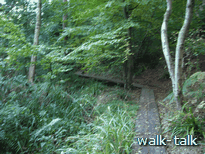 .
When we come off the boards, the line of the path is not clear.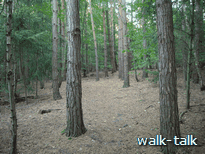
We go up a bit and left a bit and look out for
a
splodge of paint on a pine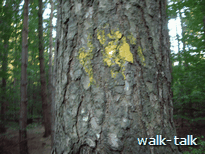 .
We bear left and see at last
a
butterfly waymark.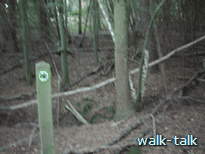
It points us right.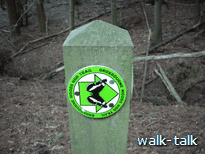
We are soon again on to boards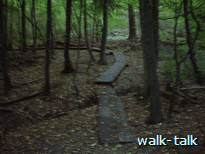 which take us over a streamlet.
When we come off the board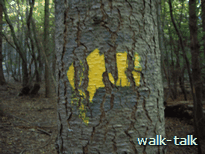 s
there is a yellow arrow on a tree to point us left but this time
the path ahead is clear.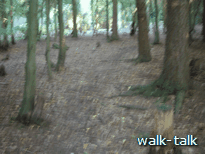
On the edge of the path is a stump
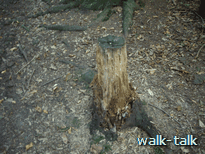 that
looks as if it has been eaten.
By what, I wonder?
Then we see our pile of timber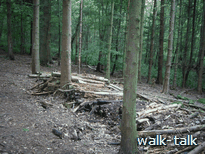 ,
this time on our right, and know to be alert.
We take the path butterfly-signed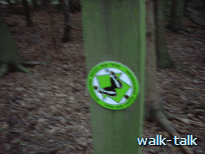 to the left.
We go through trees at first
and only then on to board s,
then on to the boards numbered 5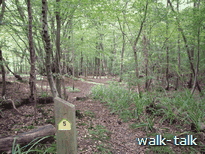 ,
on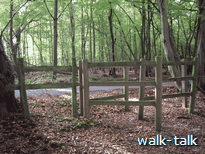 up to Pembridge Lane (point 4 on our walk),
across the
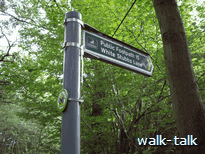 road
to the sign a little to our left,
across the board-brid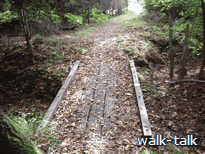 ge,
by the blackt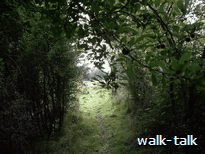 horn
into the meadow,
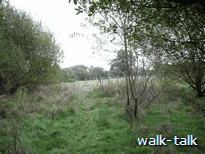
through the kissing gate and l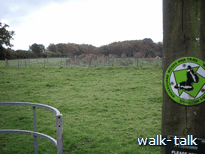 eft,
leaving the duc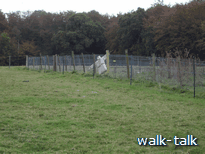 k
holiday camp well to the right,
making for
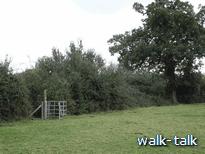 the
next kissing gate set into the hedge,
over more board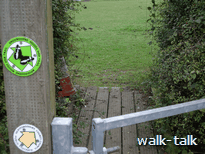 s,
angling right to the next kissing gate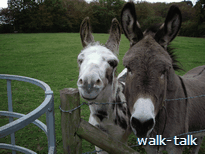 ,
and on to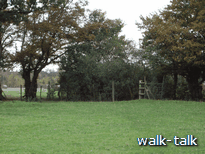 the corner with the hidden kissing gate.
We are at point 3 on our walk, the point where butterfly trails merge ( on the way up, we said "diverged").
We come out into the next meadow,
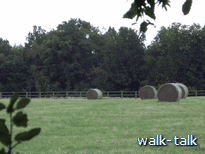
and head for the next kissi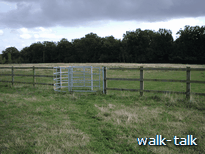 ng
gate,
and th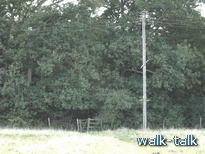 e
next, in amongst tall trees.
We go through th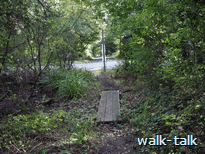 e
trees and over the boards
across White St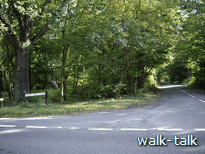 ubbs
Lane (point 2 on our walk),
and a little way into West End Lane,
then in to Emanuel Pollards
a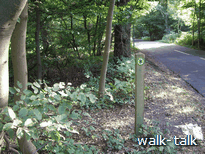 t
the butterfly waymark on the left.
I like the thick emerald moss at the ba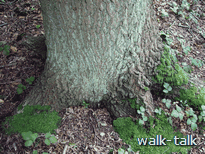 se
of an oak tree
and the lichen and moss colours together further up the
trunk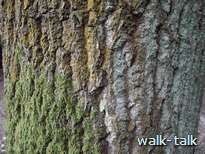 of the same tree.
There are also stro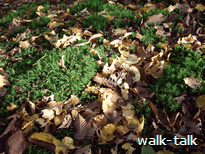 ng
colours underfoot.
We turn right a t
the Emanuel Pollards sign,
and go through the delicate hornbea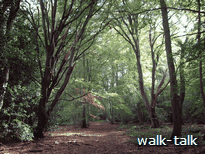 m
woods.
As the path slopes down and curves right, away from the edge of the wood on the left,
we look out for
the wooden sign to The Woodman,

and the kissing gate under the hornbea m
with a distinctive loop in its branches.
We go through the kissing gate and out into the meadow.
There is a far view acr oss
the valley ahead and beyond.
We walk on
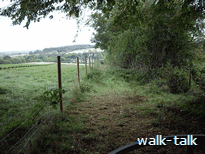 between
the line of trees on our right and the fence and meadow on the left.
The tips of some of the leaves are purple.
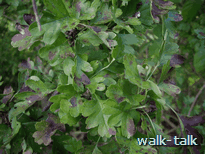
Other leaves have a redder hue.
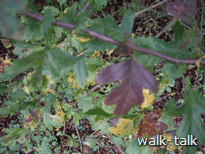
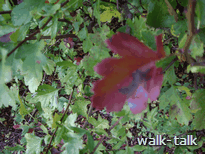
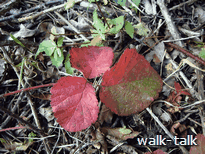
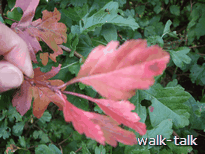
But fat-leafed hazel st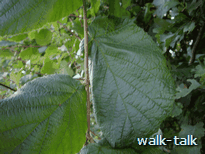 ays
determinedly green - the change is not for her.
She is quite fine as she is, thank you.
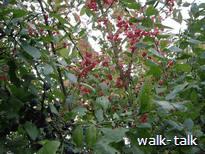
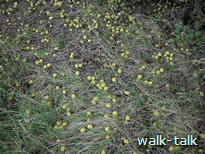
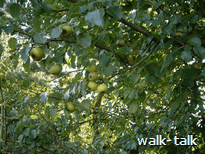
The birds and other small animals will be fine, too, on the sloes and crab apples.
We go over the stile and along path between
young pine trees 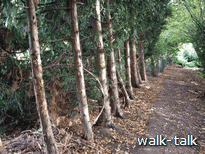
and distorted old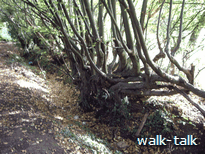 hornbeams,
out on to the road
 and
across to The Woodman.
We are back at point 1 on our walk.